
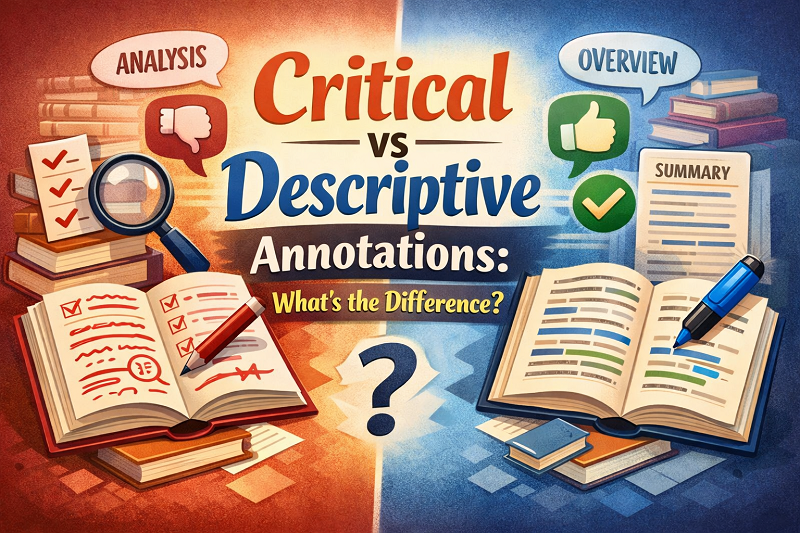
Learning how to make critical vs descriptive annotations is a role to academic excellence when preparing an annotated bibliography. Annotations are not brief descriptions, they show how well you have read involving your sources. However, descriptive annotations, summarising, critical annotations and evaluation, are confused by many students. Being able to know the difference between critical and descriptive annotations can make a big difference in your academic writing and the believability of your research.
We are going to discuss the key difference in critical and descriptive annotations, demonstrate when to use which one, and provide creative ideas to make your annotations stand out in this post.
What Are Annotations and Why Do They Matter?
It is important to first define an annotation before delving into critical vs descriptive annotations. An annotation, in simple terms, is a brief writing that comes with a citation on an academic bibliography. It will give the reader a glimpse of what the source contains, what its purpose is for your study and how valuable it is.
The annotations are not only summaries of the information, but as a display of your skills to analyze, evaluate, and interpret academic content. This is why universities usually evaluate students not only according to their sources, but also according to the level of thoughtfulness with which they annotate them.
However, when you cannot cope with this, you may always seek professional assistance of a custom annotated bibliography writing service where the professionals make certain your annotations are clear, accurate, and insightful.
Descriptive Annotations: The Art of Summarizing
Descriptive annotations are factual and simple. They also provide a summary of the main points, techniques, and conclusions of a source without any personal assessment. They are meant to tell readers what the source is about, not what you think about it.
An example would be when you are writing a descriptive annotation to a book about environmental policy and you write:
The book gives a brief on the global policies on the environment and how effective they are in reducing climate change. It throws light on international agreements and case studies in the developing countries.
Here, all you do is to describe what has been given, no individual assessment or critique.
When to apply it: Descriptive annotations are best when one is at the initial part of the research, particularly when gathering background information. They assist in arranging sources prior to you commencing the development of opinion or argument.
But one of the pitfalls is to over-summarise without providing context. To ensure the interest of your descriptive annotations, pay attention to clarity and conciseness, make sure to state the main idea of the source using as little information as possible.
Critical Annotations: The Art of Evaluation
Critical annotations on the other hand, take your writing a step higher. They do not summarize but evaluate. This is the most significant difference in critical and descriptive annotations. Critical annotation is done to evaluate the quality, credibility and relevance of the source to your research topic.
Here’s an example:
This paper is an excellent examination of renewable energy policies. Although the information presented is all inclusive, the author is too concentrated on Western economies, which restricts its universal use. However, the results can be useful in relation to the comprehension of energy policy frameworks.
Pay attention to the fact that this version is more than a description, it criticizes the attention of the author and judges the utility of the source. It is the characteristic of critical writing.
When to apply it: It is vital in case of argumentation or some sophisticated research. They demonstrate that it is possible to think on your own, to single out strengths and weaknesses, and relate concepts to your personal study.
A critical thinking paper writing service can also be useful to students who struggle with evaluation and assist them in honing their critical thinking and deepening the strength of their arguments in the academic process.
Critical vs Descriptive Annotations: The Main Difference.
| Type of Annotation | Purpose | Writing Style | Example Use |
| Descriptive | Summarizes content and purpose of the source | Objective, neutral, factual | Initial research phase |
| Critical | Evaluates the source’s value, reliability, and contribution | Analytical, reflective, evaluative | Advanced analysis or essay writing |
Conclusion
Learning the difference between critical and descriptive annotations is critical in the composition of reflective and scholarly worthy bibliographies. Descriptive annotations are clear, whereas critical annotations are an indication of your analytical skills, together they make your research more profound.
By understanding the difference between critical and descriptive annotations and using both on a strategic basis, you will be able to show a greater depth of understanding and originality. In case of uncertainty, however, you can always use the services of a critical thinking paper writing service or custom annotated bibliography writing service to revise your work until it is perfect.
When it comes to academic writing, critical and descriptive annotations are not only different in form but also quality of thought. Use the two and your writing will not only be knowledgeable but also intellectually mature.