
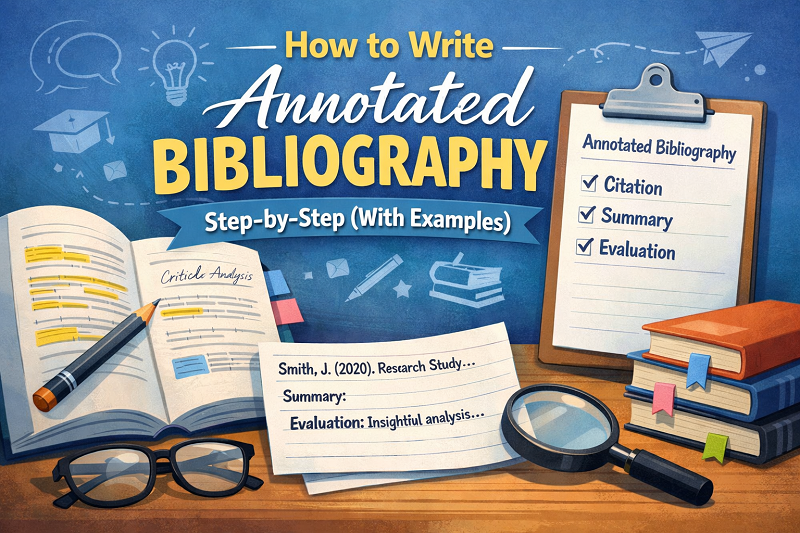
One of these skills is the annotated bibliography that is required to succeed in academics. Whether it is a research paper, thesis, or coursework, knowing how to write annotated bibliography may enable you to organize your research sources easily. An annotated bibliography does not just provide a list of references that you used, but it also summarizes and assesses each of the sources. This shows that you have comprehended the contents and that it can be useful in your work.
This blog will provide a step-by-step guide to create an annotated bibliography, tips to write annotated bibliography, and expert annotated bibliography writing tips to enable you to create accurate and well-constructed entries.
What Is an Annotated Bibliography?
An annotated bibliography is a bibliography indicating citations of books, articles, and documents. Every source is accompanied by a summary and evaluation in the form of a short paragraph (annotation). The aim is to make the readers realize the relevance, accuracy, and quality of the mentioned work.
For example:
APA Example:
Smith, J. (2022). Climate Change and Global Policy. Oxford University Press.
The book is a comprehensive examination of the climate change policies in the world and their impact in the long run. The study by Smith provides useful information on sustainable development and policymaking.
To know how to write annotated bibliography, you must first realize its two-fold nature in that you are not only to be critical of your sources but also to be able to direct other people to authoritative information.
Step 1: Choose the Right Sources
After you start writing, ensure that you choose good academic references. Credible material that you can include in your annotated bibliography are peer-reviewed journal articles, academic books or reputable websites. Do not use prejudiced and old information.
In learning to write annotated bibliography, make sure that every source answers your research question or topic. Few and strong sources are superior to many and weak sources.
Step 2: Cite the Source Properly
Your bibliography begins with a proper citation in every entry of your bibliography, in style guide that you will be using, this can be either APA, MLA, Chicago, or Harvard. Pay attention to such information as the name of the author, publication date, and the title.
Tip: Do not forget to use the latest version of your citation style. Indicatively, the 7th edition of the APA is characterised by specific rules related to electronic sources and DOI.
Step 3: Write the Annotation
Following the source quote in a citation write a brief note of 100-150 words. The three significant aspects of this annotation are:
- Summary: Summarize the point or conclusions of the source.
- Evaluation: Test the authority, veracity and applicability of the source.
- Reflection: Discuss how this source will assist your research or knowledge on the topic.
Example (MLA):
Johnson, Lisa. The Future of Renewable Energy. Green World Press, 2021.
Johnson writes about the trends of renewable energy and their economic consequences. The book presents a well-rounded view, which is justified by statistical data. It can be especially helpful to learn the models of government policy and apply to my study on sustainable development.
The following are some tips that can assist you to write an annotated bibliography to ensure that your annotations are informative besides being analytical.
Step 4: Maintain Consistency and Clarity
Consistency in formatting is vital. Apply the same font, spacing and identity throughout your bibliography. Sort by the last name of the author. In case there are several works written by a similar author, including them in chronological order.
In case of doubt, refer to the style guide or get professional assistance of a custom annotated bibliography writing service to be accurate and professional.
Step 5: Review and Edit Your Work
After trying to finish your annotated bibliography, proofread it before ensuring that it is grammatically correct, coherent and accurate. Check the citation data and ensure that you have the data that can be relevant to your subject.
Editing is a major process that most students fail to take into consideration. In case you have problems with formatting or phrasing, you can involve professional paper writers specializing in academic writing. They could help polish your bibliography to meet the standards of research of any university and report your findings.
Pro Tips for Writing a Strong Annotated Bibliography
The following are some of the recommendations that you can use in your annotated bibliography:
- Stay objective: Do not apply personal opinion or emotional words.
- Be concise: Focus on the essence of each source.
- Use academic tone: Be professional in your writing.
- Follow the structure: 1) Citation 2) Summary 3) Evaluation 4) Reflection.
- Check for plagiarism: It is always necessary to paraphrase and cite ideas appropriately.
The following tips to write annotated bibliography may assist you in your presentation of research in a coherent, convincing, and properly organized way.
Conclusion
Learning to write annotated bibliography is a key ability every student or researcher should possess. An annotated bibliography should be a well-written paper that does not only bolster your scholarly work but also portrays your capability to think and judge information critically.
By adhering to these tips of writing an annotated bibliography and having an organized structure, you will come up with an amazing bibliography that will facilitate your research objectives. And in case you do require professional advice, you can use reliable sources as a custom annotated bibliography writing service or professional paper writers so that your work can be of the highest academic quality.
A good, annotated bibliography is not merely a list of references, but a statement of your scholarly knowledge, critical thinking, and honesty.