
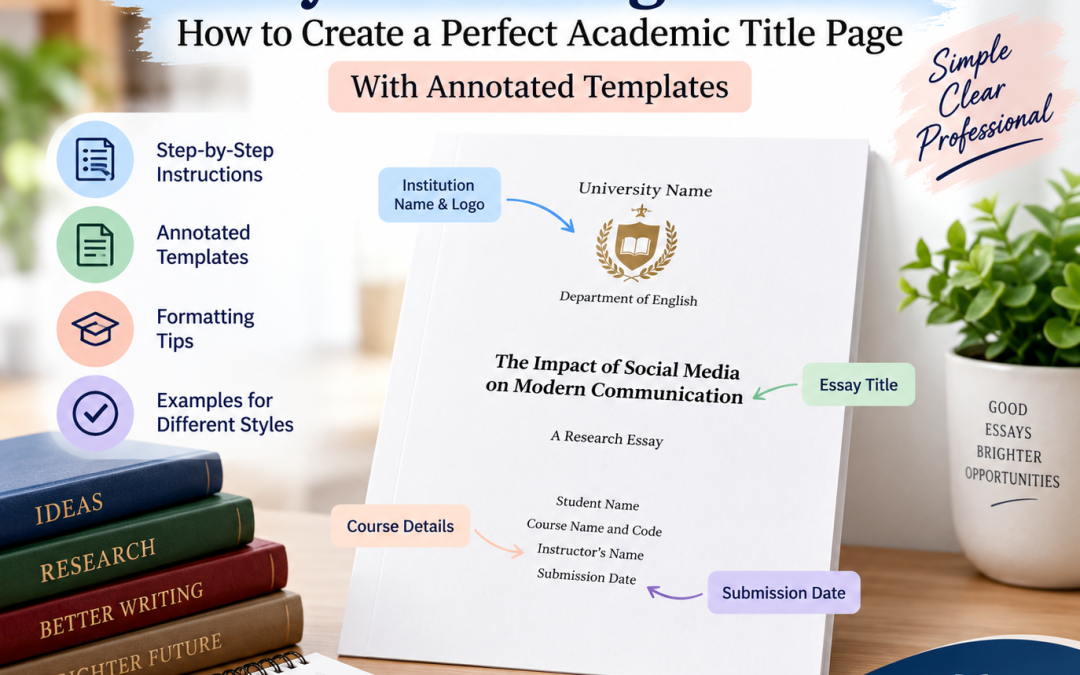
Essay Cover Page Guide: How to Create a Perfect Academic Title Page
Before an instructor reads the first sentence of your essay, your cover page has already created an impression.
A well-designed academic cover page may look simple, but it plays an important role in presenting an assignment professionally. It tells the reader who wrote the paper, what the assignment is about, which course it belongs to, and when it was submitted. More importantly, it shows that the student has paid attention to academic formatting requirements.
The challenge is that there is no single cover-page format that works for every academic paper. APA, MLA, Chicago, ASA, and Harvard have different requirements, while universities and individual instructors may introduce additional rules.
This guide explains how essay cover pages work, when you need one, what information to include, and how to format title pages according to the most common academic styles.
What Is an Essay Cover Page and Why Does It Matter?
An essay cover page, commonly called a title page, is a separate page positioned before the main content of an academic assignment. Instead of presenting arguments or evidence, it provides essential identifying information about the paper, student, and course.
A typical title page may contain:
- Essay or research paper title
- Student’s full name
- Course title or course number
- Instructor’s name
- University or institution
- Submission or due date
- Student identification number, when required
- Final word count, when requested
Students who want additional guidance with organizing and presenting academic assignments may also explore resources offered by best essay writers while learning appropriate academic conventions.
Why Is a Cover Page So Important for Academic Papers?
The title page may contain only a small amount of text, but its role should not be underestimated.
It creates the first visual impression of an assignment and demonstrates whether a student has followed the instructions carefully. A neat, accurate title page suggests professionalism and attention to detail before the instructor begins evaluating the actual essay.
It also serves a practical purpose. Instructors handling dozens or even hundreds of assignments need to identify papers quickly. Clearly displaying the student’s name, course, assignment title, and other requested information makes organizing submissions easier.
Small errors can undermine this professional presentation. Misspelling an instructor’s name, entering an incorrect module code, or forgetting the submission date may suggest that the assignment was not checked thoroughly before submission.
Do You Actually Need a Cover Page? Check Before You Submit
Not every academic essay requires a separate title page.
Whether you need one depends primarily on the citation style, type of paper, university guidelines, and instructor’s directions.
A separate cover page is commonly required for:
- APA-style academic papers
- Research reports
- Dissertations and theses
- Assignments where a title page is specifically requested
- Certain professional and academic manuscripts
A separate cover page may not be necessary for:
- Standard MLA essays unless specifically requested
- Short classroom assignments
- Informal academic writing
- Assignments whose instructions state that no title page is needed
When the requirements are unclear, students should consult the assignment instructions or ask their instructor rather than making assumptions.
APA vs. MLA vs. Chicago: Are Cover Pages Really Different?
Yes. One of the biggest mistakes students can make is assuming that every academic cover page follows the same structure.
Citation styles have different rules concerning which information should appear, where it should be positioned, whether page numbers are necessary, and whether a separate title page should exist at all.
APA generally uses a dedicated title page. MLA commonly places student information on the first page of the essay instead. Chicago may use a separate, minimalist title page, while ASA and Harvard introduce their own requirements.
How to Make a Professional Essay Cover Page in Minutes
Regardless of citation style, a few basic practices can help students create cleaner and more professional title pages.
First, confirm the required formatting style before beginning the assignment. Changing an entire document from one style to another at the last minute can require unnecessary work.
Use a consistent academic font throughout the paper unless the instructions state otherwise. Depending on institutional requirements, commonly accepted choices can include Times New Roman, Arial, and Calibri.
Margins should also remain consistent. One-inch margins are common in academic papers, although students should always prioritize the specifications supplied by their institution or instructor.
Most importantly, verify every detail before submitting. Check the spelling of names, course titles, module numbers, dates, and other identifying information.
When possible, finalize the title page after completing the essay. Doing so allows the student to insert the final paper title, accurate word count, and correct submission details.
APA Cover Page Format: What Should You Include?
APA style is widely used in disciplines such as psychology, education, nursing, and the social sciences. Student papers prepared according to APA guidelines generally require a separate title page.
A standard student APA title page usually includes:
- Full title of the paper
- Author’s name
- Institutional affiliation
- Course number and course name
- Instructor’s name
- Assignment due date
- Page number
The paper title and identifying information should be clearly presented and properly spaced according to APA requirements.
Student papers generally do not require a running head under current APA guidelines, although requirements for professional papers can differ.
Students should also avoid adding decorative elements that are not required. The objective is a clean, readable, professional academic presentation.
MLA Cover Page Format: Do You Even Need a Title Page?
MLA 9th Edition is commonly used for literature, languages, and other humanities subjects.
Unlike APA, MLA usually does not require students to create a separate cover page. Instead, identifying information is generally placed in a heading at the beginning of the first page.
This heading commonly includes:
- Student’s full name
- Instructor’s name
- Course information
- Submission date
The essay title normally appears below this information, followed by the introduction.
However, an instructor can still request a separate MLA title page. When that happens, students should follow the assignment instructions rather than assuming that a title page is prohibited simply because MLA normally does not require one.
Students facing tight academic deadlines may search for options such as buy college paper online, but any submitted work should comply with their institution’s academic-integrity requirements.
Chicago Style Cover Page: A Simple Format That Looks Professional
Chicago style is frequently encountered in history and certain areas of the humanities and social sciences.
Its title page is generally straightforward and uncluttered.
A typical Chicago-style cover page may include:
- Full essay title
- Student or author’s name
- Course information
- Instructor’s name
- Submission date
The title is commonly positioned around one-third of the way down the page, with additional identifying details appearing farther below.
Unlike an APA title page, a traditional Chicago title page generally avoids unnecessary elements. Page-number treatment can also differ, so students should follow the specific Chicago or institutional guidelines assigned to them.
ASA Cover Page: Key Details Sociology Students Should Know
ASA style is primarily associated with sociology. Although it shares certain characteristics with other academic styles, its title-page requirements can be more detailed.
An ASA title page may contain:
- Complete paper title
- Author’s name
- Institutional affiliation
- Running head
- Paper word count
- Relevant contact information
- Acknowledgements or funding information where applicable
Professional manuscripts may require more information than ordinary student assignments.
Universities can simplify these requirements for coursework, so students should always compare general ASA conventions with the directions supplied for their specific assignment.
Harvard Cover Page Format: What Universities Commonly Require
Harvard referencing is widely used by universities, particularly in the United Kingdom, Australia, and other countries.
One important point is that Harvard formatting is not always identical between institutions. Universities frequently maintain their own versions of Harvard referencing and provide specific assignment-presentation requirements.
A Harvard-style cover page commonly includes:
- Assignment or paper title
- Student’s full name
- Student identification number
- Course or module code
- Instructor or supervisor
- Submission date
- Word count
A university may additionally request the department, faculty, program, or other identifying information.
Because institutional variations are common, students should consult their university’s official style guide before finalizing the title page.
7 Cover Page Mistakes That Can Make Your Essay Look Unprofessional
Even a simple title page can contain mistakes. Before submitting an academic paper, students should check for common problems such as:
- Using the wrong citation style.
- Misspelling the instructor’s name.
- Entering an incorrect course or module number.
- Forgetting required student information.
- Using inconsistent fonts or spacing.
- Adding unnecessary graphics or decorative elements.
- Ignoring institution-specific formatting instructions.
A professional cover page should prioritize accuracy and readability over creativity.
Decorative fonts, excessive formatting, illustrations and color elements generally don’t add value to academic assignments unless they have been expressly asked for.
Sample papers created by best essay writers can also be used to illustrate the significance of formatting and presentation in formal papers for students who are learning the process of organizing formal papers.
The Final Cover Page Checklist: Check These Before Clicking Submit
Check the cover page against the actual directions one last time before turning in the assignment.
Verify the title and the correctness of the student’s name, the instructor’s name, the course information, the date of submission, and such other identification information as may be needed.
Next, check alignment, spacing, margins, fonts and page number requirements.
When a word count is requested, be sure to include the final word count for the assignment, not for an earlier draft.
Lastly, make sure that the style you selected is indeed APA, MLA, Chicago, ASA, Harvard or whatever style is requested.
Students who want convenient academic writing support can explore services that allow them to buy college paper online and choose the assistance that best suits their academic needs.
Final Thoughts: A Small Page that Can Make a Big First Impression
Although it’s one of the shortest sections of an academic assignment, a cover page serves an important purpose. It shows that the student has included information about the paper, important student and course data, and that the student has adhered to the academic standards of presenting the paper.
There are different titles page formats to follow for APA, MLA, Chicago, ASA, and Harvard. Some may need their own cover pages; others might have identifying information on the first page. There is also the option for universities and instructors to adjust the standard requirements.
The best way to go about it is simple: read the assignment directions, adhere to the specific style of citations, double check all of the information, and keep the design professional.