
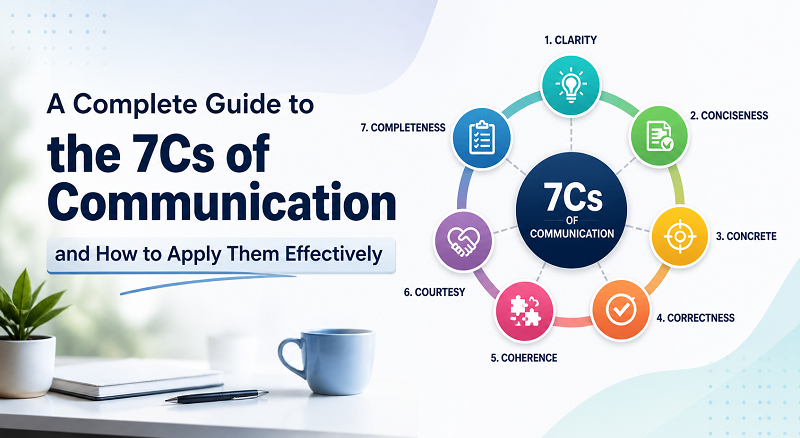
One of the most significant skills in academic, professional, and personal life is an effective communication. Whenever an individual is writing an email, making a presentation, speaking at a meeting, writing a report or explaining an idea, the message should be clear, focused, and comprehensible. Ineffective communication may lead to confusion, errors, delays, and misunderstandings. Effective communication, in turn, fosters trust, time-saving, enhanced teamwork, and assists individuals in attaining superior outcomes. This article is a full-fledged guide to 7cs of communication and how the concepts can be worked out in everyday life.
The 7Cs of Communication: What is their Meaning?
It would be good to know what is 7cs in communication and why it is important before using the model. The 7Cs are the seven principles that assist in making communication more effective. These are the principles of clarity, brevity, completeness, accuracy, being concrete, courtesy, and consideration. Both principles are aimed at how the quality of a message can be enhanced to make it easy to comprehend by the receiver so that he/she can respond accordingly.
The 7Cs can be applied in both written and spoken communication. Their application can be used in business emails, academic essays, workplace discussions, customer service, interviews, presentations, and leadership communication. By adherence to these seven principles, communication will be more professional, meaningful, and result-oriented.
Concise Communication
Concise refers to the use of fewer words in communicating the message with no loss of meaning. A brief message does not waste the time of the reader or the listener. It does not contain redundant information, duplication of concepts, and lengthy discussions that are not value adding.
As an illustration, the sender should concentrate on the point rather than writing a long email that does not include the background information that is not related to the actual point. Brief communication is neither concise nor rude. It refers to the meaning by saying what should be said, straightforwardly and practically. This is also a valuable inclusion in any guide to 7cs of communication, as contemporary communication may be fast and may occur in the form of emails, messages, and meetings.
Completeness in Communication
Completeness refers to the ability to give all the information required in the message by the receiver to interpret and act. A partial message is a source of confusion and might need some follow-up questions. A comprehensive message is the one that provides answers to key questions: who, what, when, where, why, and how.
To illustrate, when a manager requests an employee to join a meeting, it should be indicated who should be there, when, where, why, and what will be needed in preparation. In the absence of such information, the employee might not be well prepared. With full communication, there is no time wasted, and the receiver is well-informed to take the right course of action. Students can seek guidance from professional essay writers to improve academic structure, research quality, originality, and overall writing clarity.
Correctness in Communication
Correctness refers to the application of correct information, good grammar, spelling, and the use of appropriate language. Messages that are erroneous can ruin credibility and cause misconceptions. In academics and work environments, correctness is concerned with attention to detail and the esteem of the receiver.
Factual accuracy also amounts to correctness. In case an individual posts inaccurate information, false dates, and misinformation, communication cannot be trusted. As an illustration, a business report ought to have proven numbers, and an academic essay ought to employ precise sources. The interpretation of what is 7cs in communication also presupposes the awareness that the correct communication is not just a question of style but also of precision.
Consideration in Communication
Consideration is the concept of reflecting on what the receiver needs, their background, feelings, and understanding level. A good communicator does not just say what he/she wants to say. They also consider the way the receiver is going to interpret the message.
In case of a technical subject, for example, when explaining a subject to beginners, the speaker should not use complicated terms and give simple examples. The person sending the message should be able to address the needs and concerns of the client when communicating with him or her. Consideration is audience-oriented and effective communication. The most effective guide to 7cs of communication must always focus on the need to vary the message as per the receiver.
The 7Cs and How to Implement Them
The use of the guide to 7cs of communication involves being aware of and practicing them. The sender must consider that the purpose of communication are the message is clear, concise, complete, correct, concrete, courteous and considerate before sending a message. This very review can enhance the level of communication significantly.
In written communication proofreading is crucial. The author ought to use check sentence structure, grammar, spelling, tone, and omissions. In oral communication, the speaker must prepare their thoughts and then speak, the language must be simple, the speaker should have a respectful tone, and they should be keen to listen to the reply of the receiver. Communication is not just talking or writing effectively, but also listening, comprehending, and reacting properly. Students can use buy college paper online services as a learning support option to understand essay structure, improve research quality, and write more confidently.
7Cs of Communication and Their Application
| 7C Principle | Meaning | How to Apply It |
| Clarity | Making the message easy to understand | Use simple words and a clear purpose |
| Conciseness | Keeping the message brief but meaningful | Remove unnecessary words and repetition |
| Completeness | Providing all required information | Include who, what, when, where, why, and how |
| Correctness | Using accurate facts, grammar, and spelling | Check information and proofread before sending |
| Concreteness | Making the message specific and detailed | Use facts, figures, and examples |
| Courtesy | Communicating politely and respectfully | Use a professional and positive tone |
| Consideration | Thinking about the receiver’s needs | Adapt language and tone to the audience |
Importance of the 7Cs in Academic and Professional Life
The 7Cs are important because they help people communicate with confidence and professionalism. In academic life, students can use these principles to write better essays, give presentations, participate in discussions, and communicate with teachers. In professional life, employees can use the 7Cs to write emails, prepare reports, attend meetings, handle clients, and work with teams.
When people understand what is 7cs in communication, they become better at organizing their ideas and delivering messages effectively. These principles reduce confusion, improve relationships, and support better decision-making. They are useful for students, managers, business owners, teachers, employees, and anyone who wants to communicate more effectively.
Conclusion
The 7Cs of communication are a powerful framework for improving the way people share ideas, information, and instructions. Clarity, conciseness, completeness, correctness, concreteness, courtesy, and consideration work together to make communication more effective and professional. By applying these principles, students can improve academic writing, employees can perform better at work, and leaders can build stronger relationships with their teams. Good communication is not only about sending a message; it is about making sure the message is understood in the right way.