
Why 2026 Is a Turning Point for Smarter Student Learning
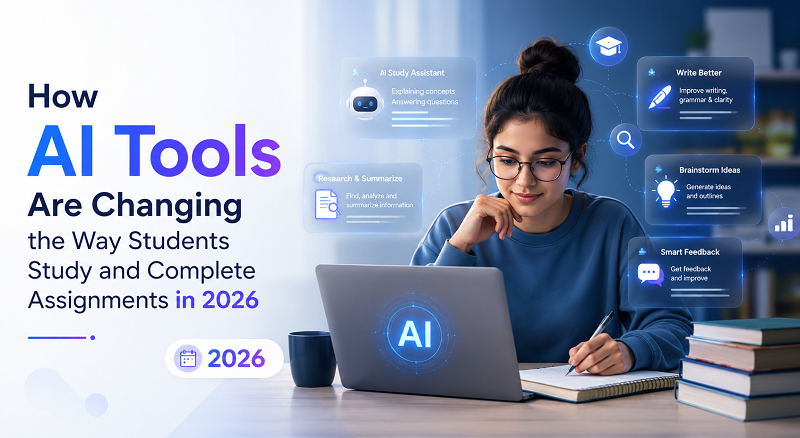
Education in 2026 looks very different from the traditional classroom model students once knew. Instead of depending only on textbooks, lecture notes, and long hours of manual research, students now use digital support systems that help them learn faster, organize better, and complete assignments with more confidence. Artificial intelligence has become one of the most powerful changes in modern academic life because it supports students at almost every stage of learning.
The rise of the best AI tools for students in 2026 has made studying more flexible, personalized, and efficient.
Students can now ask questions, summarize difficult topics, create study plans, check grammar, generate ideas, and review complex concepts in minutes. This does not mean students no longer need effort or critical thinking. Instead, AI works best when it supports students rather than replacing their own understanding. In 2026, successful students are learning how to use AI wisely, ethically, and responsibly.
The New Study Partner Every Student Wants
Personalized learning is one of the most notable transformations in how AI is changing education. In the old days, all students used to get the same note, the same lecture, and the same homework, even though learning speed was different. Some pupils grasped the concepts easily; others required more explanation. AI tools have emerged to bridge this gap and provide personalized assistance to students according to their level.
AI for learning and homework assists students in understanding complex topics more easily.
For instance, a student who is having trouble with business management, science, programming, or academic writing can use AI to comprehend definitions, examples, formulas, and structures of essays. AI can define the same thing in different ways until the student understands it very well. This can be particularly helpful to international students, part-time workers, and students requiring additional academic assistance outside of normal class hours.
AI can also be used to help students revise better. To avoid re-reading lengthy chapters over and over, students can prepare summaries, flashcards, quiz questions, and revision schedules. This will save time and allow pupils to concentrate on weaker areas before the examination.
High-Impact Ways AI Helps Students Complete Assignments Faster
One thing that students find to be the most stressful in their lives is assignments. Some of the most common challenges students face are selecting a topic, locating sources, structuring a paper, developing an introduction, refining their grammar, and editing their paper. AI has revolutionized this journey, making assignment work more organized and manageable.
AI is transforming education in numerous ways, and one of the most evident is the shift in how students approach academic writing.
Students will use AI to brainstorm ideas, develop outlines, clarify assignment questions, and enhance sentence clarity, rather than starting from scratch. AI can assist students in recognizing their own weak or unclear sentences, repetitious sentence structures, and/or the absence of key points. This will cause the writing process to be less confusing and more structured.
Students need to note, however, that while they can use AI to provide a starting point, they should not copy entire assignments and submit them as their own. Universities are increasingly aware of AI-generated content, and academic integrity remains important. The best idea is to plan, learn, edit, and improve with the use of AI, while maintaining the authenticity and individuality of the final product.
Why AI is Making Learning More Personalized Than Ever
Each pupil’s learning style is unique. Some learn best by hearing it, while others need examples or summaries, diagrams or practice questions, or step-by-step explanations. The AI tools enable students to learn how they like. This is one of the reasons for the popularity of AI in 2026.
The best AI tools for students in 2026 are more than just writing aids—they are learning companions.
They can assist with time management, note-taking, language development, research, coding assistance, presentation preparation, and examination revision. With their proper usage, students can manage their workload more effectively and can minimize academic stress.
AI can also help out students who are hesitant to ask questions in class. They can ask the same question as many times as needed without feeling embarrassed with AI. They can ask for easier explanations, examples, or practice questions. This allows the students to learn independently and to have more control over their learning.
The Role of AI in Research, Notes, and Exam Preparation
AI has also significantly impacted research. Students have been spending hours looking for information, reading long articles, and trying to understand academic sources. AI can be used to get the main ideas of research texts, find important points, and group notes into sections.
When students have several assignments to complete with various deadlines, AI tools for studying and assignments are particularly beneficial.
For instance, a student might have an essay, presentation, quiz, and group project due in one week. AI can be used to develop a study schedule, break down tasks into smaller ones, and prioritize tasks based on their importance. This helps students not to panic at the last moment and makes them productive.
In the preparation for exams, AI can create practice questions, explain incorrect answers, and even provide quick revision notes. This will enable pupils to practice testing themselves before the test. Students can no longer just memorize information but also learn concepts in depth and apply them properly with AI.
AI and Academic Skills for the Future
While there is a risk of laziness, the use of AI by the students will determine this. Pupils who only copy answers with AI may miss out on crucial abilities. However, with AI, they can enhance their learning skills by asking questions, making revisions, and self-improving to strengthen their academic abilities.
One of the most compelling examples of the impact of AI in education is the paradigm shift from passive learning to active learning.
No longer having to wait for teachers or tutors. They can investigate on their own, compare explanations, and practise until they get better. This makes the learning more active,e and students are responsible for their progress.
AI also enhances digital literacy. In 2026, students must be able to create effective prompts, critically assess AI-generated content, verify information, and responsibly use technology. These are useful skills for the future as well as for University. The importance of digital tools, automation, and AI-supported work processes is growing, and employers have high expectations for graduates to grasp these.
The Ethical Side Students Cannot Ignore
While AI has a lot of advantages, students need to be cautious. AI may occasionally give wrong information, weak references, or general writing. It is important for students to always revise, fact-check, and personalize the work assisted by AI. AI cannot be trusted blindly and might result in low academic outcomes.
The best AI tools for students in 2026 are those that they use in conjunction with their own research and critical thinking.
Honesty in academic work is also a factor. Many institutions have well-defined policies regarding the use of AI. Some enable AI for brainstorming and editing, while others limit its use in formal submissions. Before using AI for coursework, students are advised to consult with the University’s directives and guidelines. Appropriate use will shield students from plagiarism issues and will enable them to develop true knowledge.
AI will serve as a study aid, not a substitute for study. The aim should not be to remove the effort; it should be to improve understanding. By embracing AI responsibly, students can save time while simultaneously honing their academic abilities. Students who want guidance with structure, research, and editing can use an online essay writing service to improve the quality of their academic work responsibly.
How can Students Leverage AI Without Compromising Originality?
There is still the factor of original thinking, one of the most important aspects of education. It is important to note that AI can provide suggestions, but students should incorporate their own ideas, examples, experiences, and analysis. This helps to make assignments more authentic and meaningful.
AI tools for studying and assignments can be used to help maintain originality, provided they are used for guidance rather than copying.
For instance, students can pose a question to the AI about a topic and then compose the response in their own language. They can use AI to help with their grammar, but the argument must be their own. They can request an outline, but the structure should show their knowledge of the question related to the assignment. Students who need clear analysis, strong structure, and polished academic language can benefit from a professional movie review writing service for guidance and support.
Final Thoughts: The Smart Student’s Advantage in 2026
AI is already an integral component of students’ lives and will assume an even larger role in the future. Whether it’s studying, writing assignments, researching, or revising for exams, AI provides valuable resources for students to tackle academic challenges more efficiently.
The most significant takeaway in how AI is changing education is that it is most effective when it is used to augment, but never to replace, human effort.
The AI responsible usage knowledge will be a significant asset for students in 2026. They will learn to study more efficiently, to manage their time more effectively, to write more effectively, and to prepare for tests with more confidence. But the success is still dependent on honesty, critical thinking, and personal effort.