
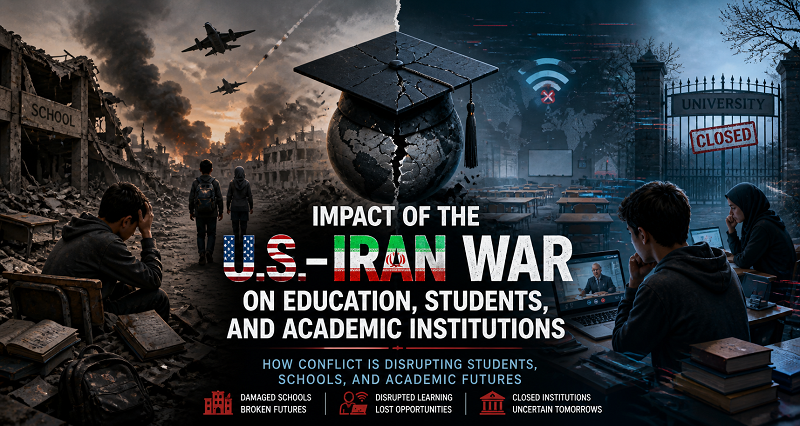
War does not only impact on the military targets and political systems. It interferes in classrooms, universities, research networks, the mobile life of students, mental health, and the future of the youth in a long-term perspective.
Education is among the most susceptible areas in any hostilities between the United States and Iran since schools and universities rely on the security, stability, funding, transport, digital connectivity, and international collaboration. This internal blog discusses the US Iran was influence on education by addressing the issues of students, teachers, academic institutions and the learning environment in general.
It has been repeatedly stated by the international organizations that schools, students, teachers and education personnel are to be secured in the case of conflict. According to UNESCO, the assaults on education institutions threaten students and teachers and deprive people of their right to education. This indicates that this is not just a political or military problem, but a humanitarian and scholarly problem as well.
School Disruption and Interruption of Learning
Destruction of day-to-day education is one of the most direct impacts of war. Schools can be shut down due to threats of safety, transport issues, impaired infrastructure, or emergency government directives. Students may lose access to classrooms, teachers, libraries, and laboratories, exams and learning routines. A couple of weeks disturbance can cause severe learning gaps particularly among young students and those who are about to take some critical tests.
Displacement of families, lack of stability in the internet and the use of schools as shelter or as emergency facilities can make the education crisis in US and Iran war even worse. Under this kind of circumstances, education is taken as secondary to survival. Nonetheless, prolonged pauses in education hurt children self-esteem, undermine the academic growth, and promote disparity between those students who can go on with the education online and those who cannot.
Effect on Mental Health of the Students
War has a tendency to affect students and make them feel scared, stressed, grieved, vulnerable, and emotionally drained. They can be concerned with parents, siblings, friends, houses, food, protection or future prospects. The negative impact of such emotional pressure is directly on concentration, memory, motivation, and classroom performance.
A student cannot be able to concentrate on assignments and exams in case the student lives in the fear of conflict.
Students at the university might experience even more stress since they might be career planning, planning a research project, internship, a scholarship or an international study. The Iranian students in foreign countries might be concerned about the relatives at home whereas the student in the United States can have anxiety related to the tension on the campus, discrimination or uncertainty about the policy. Mental health assistance thus becomes a necessity to both the local and international students. Students may search for buy thesis online when they need academic guidance on complex topics like the U.S.–Iran war’s impact on education, research, and institutions.
Impact on Academic Institutions and Universities
War has a far reaching effect on universities as it relies on stable campuses, research facilities, laboratories, libraries, funding and international academic collaborations. In the event of an outbreak of a conflict, universities can suspend face-to-face classes, shift teaching to the internet, delay exams, cancel academic conferences, or delay research projects. Students of medicine, engineering, science, and technology are particularly affected since their studies may entail on-the-job training and access to laboratories.
UNESCO has also been very concerned with the developments that have been taking place in the institutions of higher learning in the Middle East and has criticized the attacks and threats to universities and learning institutions. This issue is directly related to the US Iran war impact on education since higher education is not only a matter of degrees but also of research, innovation, professional development, and national growth.
Mobility and Visa Problems of Students
The mobility of international students can be badly impacted by war. Students will experience visa processing delays, travel bans, flight cancellations, embassy closures, financial uncertainty or transferring of academic records. The Iranian students seeking to study in foreign countries might not be able to get a visa or travel freely. Study-abroad opportunities may also be lowered or cancelled by American students focusing on Middle Eastern studies and international relations, conflict resolution, or regional research.
The last couple of years has seen the emergence of visa and policy ambiguity of Iranian international students in the US, with issues surrounding student visas and post-study work permits. In that regard, education crisis in US and Iran war not only impacts students within conflict zones, but also students studying abroad, who, all of a sudden, have their legal, academic, and career plans put under stress.
Academic Freedom and Research Collaboration
Academic studies require cross border cooperation. Medicine, public health, engineering, climate change, agriculture, artificial intelligence and social sciences are commonly collaborative areas among scholars. The US Iran war impact on education will undermine such collaborations by establishing legal barriers, sanction issues, communication and travel issues and political mistrust.
The researchers can evade sensitive topics due to the fear of criticism, monitoring, or institutional risk. Joint conferences, exchange programs, and publication partnerships also can decrease. This undermines the freedom of academia and minimizes chances of knowledge-sharing. Isolating universities denies the students exposure to different ideas, global networks and the opportunity to engage in higher levels of research. Students can use a custom thesis writing service for academic guidance, research support, and better structure on complex education-related topics.
Economic Stress on Student and Colleges
War is a burden to families, students and universities. The access to education can be decreased by inflation, currency instability, increased travel expenses, and damaged infrastructure, emergency spending, etc. Families might not be in a position to afford the tuition fees, purchase books, internet access, or children studying in a different city or country.
Colleges can also incur an increased cost of campus security, online learning, emergency communication, insurance, repair, and student support services. There is a risk that budget pressures of the governments can be exerted upon the public institutions when there is a change in government expenditure towards defense and emergency response. The US Iran war impact on education is an aspect that incorporates direct interference and economic harm indirectly.
Long-Term Consequences for Students
The long-term consequences of war on education can last for years. Students may graduate late, lose scholarships, change career plans, or leave education entirely. Younger students may struggle to recover from learning loss. University students may lose research time, internship opportunities, or international placements.
Countries affected by conflict may also experience brain drain as talented students and academics move abroad for safety and stability. This damages national development because education is closely linked to innovation, healthcare, technology, governance, and economic progress.
Conclusion
The US Iran war impact on education would be serious, wide-ranging, and long-lasting. It would affect schoolchildren, university students, teachers, researchers, international scholars, and academic institutions. Education systems can survive conflict only when governments, universities, and international organizations protect learning as a basic right.
To reduce damage, institutions must focus on safety, flexible learning, mental health support, digital access, fair academic policies, and international cooperation. War may interrupt education, but strong planning and responsible leadership can help students continue learning and protect their future.